









Nvidia co-founder Jensen Huang has resigned as chief executive, president and a member of the board after an extraordinary week of scrutiny. The chipmaker confirmed the leadership transition on November 12, 2026, naming longtime finance chief Colette Kress as interim CEO while its directors search for a permanent successor.
A historic departure for the AI chip industry
Nvidia formally disclosed in a filing with the US Securities and Exchange Commission that its board accepted Jen-Hsun “Jensen” Huang’s resignation on November 11, effective immediately. A public announcement followed on November 12. Huang had run the company since its founding in 1993, presiding over its evolution from a graphics-chip specialist to one of the central suppliers of processors and software for artificial intelligence.
The change leaves Nvidia facing an unprecedented leadership transition at a sensitive moment for the semiconductor industry. Developers, cloud providers and some of the world’s largest technology companies rely on Nvidia’s accelerated-computing ecosystem for AI model training and deployment. The company has said its operations and product roadmap should continue without interruption.
What Nvidia has confirmed
- Huang resigned as president, chief executive officer and a member of the board.
- Colette Kress, Nvidia’s executive vice president and chief financial officer since 2013, became interim CEO and will continue as CFO.
- The board began a search for a permanent chief executive, considering internal and external candidates.
- Director Harvey C. Jones was appointed Nvidia’s first separate chair of the board.
- Nvidia was due to publish its fiscal 2027 third-quarter financial results on November 17.
The independent board investigation
On November 8, Nvidia’s directors announced an independent investigation after media reports claimed Huang had been targeted by a foreign intelligence effort. An independent committee, supported by outside legal counsel, was appointed to examine the circumstances. At that point, the board said it had no reason to believe national security or Nvidia’s secrets had been compromised.
Subsequent reporting connected the controversy to alleged personal relationships and suspicions involving a person accused of links to Chinese intelligence. These are allegations and subjects of reporting, not established findings of espionage or proof of any illegal conduct by Huang. China has denied espionage accusations. Nvidia’s formal resignation statement does not itself identify a legal offense or announce a completed investigation.
The distinction matters: the fact of Huang’s resignation is documented in a regulatory filing; the allegations and any possible implications for national security remain separate questions requiring evidence and investigation. No independent finding described in the company’s public announcement proves that proprietary technology was stolen.
Who is Colette Kress?
Colette Kress has served as Nvidia’s chief financial officer since September 2013, helping manage the financial expansion that accompanied the rise of GPUs and AI infrastructure. Before joining Nvidia, she held senior finance roles at Cisco, Microsoft and Texas Instruments. Nvidia says she will retain her finance responsibilities while acting as chief executive.
Her appointment provides continuity for shareholders and business partners. In its official statement, Nvidia’s new board chair Harvey Jones expressed confidence in her experience and in the leadership team. Kress said she would build on the foundation established over Nvidia’s previous 33 years and maintain its focus on customers, developers, partners and investors.
Investors react to a shock leadership change
Nvidia shares came under heavy pressure following the departure announcement, as investors confronted the loss of the executive closely associated with the company’s AI strategy. Reuters reported that the stock closed approximately 4.3% lower on Thursday after more severe intraday declines. Such price movements reflect immediate investor reaction; they do not in themselves determine Nvidia’s longer-term performance.
The departure raises questions about management continuity, the company’s major capital commitments and how Nvidia will balance ambitious AI infrastructure investments with financial discipline. Analysts and investors have also noted that Kress previously provided a financial counterweight to some of Huang’s bolder investment plans, according to people cited by Reuters.
Why Nvidia’s leadership matters beyond the company
Nvidia hardware and software support AI research, enterprise data centers, cloud computing, scientific simulations, robotics and high-performance workloads. Its ecosystem includes GPUs, networking technologies and CUDA software. That reach means decisions about product schedules, customer allocation and investment partnerships can affect businesses far beyond the chipmaker itself.
However, a chief executive’s departure does not automatically interrupt chip manufacturing, existing customer contracts or software support. Those depend on larger operational teams and established business processes. Nvidia has emphasized that its strategy and technology roadmap will continue, even while a permanent successor is sought.
A new board chair and a search for a successor
Nvidia also appointed longtime director Harvey C. Jones as the company’s first board chair. The move separates board leadership from the interim chief executive role during the transition. The board says its search for a permanent CEO will evaluate candidates from both inside and outside Nvidia. No permanent appointment had been announced as of November 13.
Key dates in the Nvidia crisis
- November 8, 2026: Nvidia’s board announces an independent investigation following reporting about an alleged foreign intelligence effort.
- November 11, 2026: The board accepts Huang’s resignation and appoints Kress as interim CEO, according to the SEC filing.
- November 12, 2026: Nvidia publicly confirms the change, announces Harvey Jones as chair and says it is searching for a permanent leader.
- November 13, 2026: Investors, industry analysts and customers continue to assess the implications of the transition.
- November 17, 2026: Nvidia is scheduled to report fiscal third-quarter results, offering an important test of management’s communication with investors.
What happens next?
Attention will now focus on whether Nvidia’s board releases further findings from the independent investigation, which executive becomes permanent CEO and how the company explains its strategic priorities. Its upcoming earnings release and leadership communications may provide more detail about customer demand and planned investment.
For the AI industry, the immediate factual picture is clear: Jensen Huang has left Nvidia’s top leadership positions, Colette Kress is in charge on an interim basis, and an independent investigation was launched before the announcement. The full facts underlying the controversy have not been established in the company’s public filings.
Sources and editorial transparency
- Nvidia Investor Relations — official leadership transition, November 12, 2026
- US Securities and Exchange Commission — Nvidia Form 8-K
- Nvidia Board statement — independent investigation, November 8, 2026
- Reuters — Colette Kress and the leadership transition
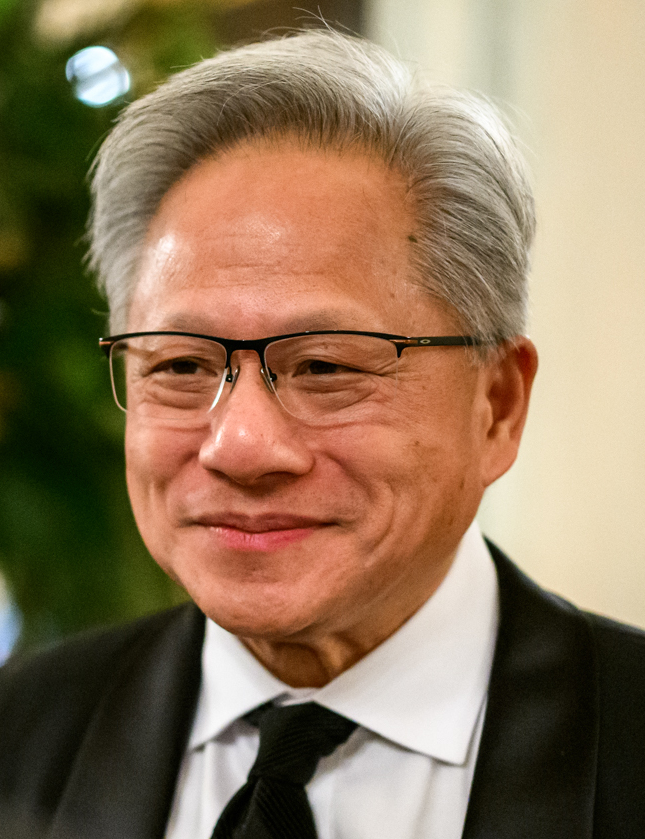
Novora24 editorial note, November 13, 2026: This report distinguishes confirmed corporate actions from reported allegations and unresolved investigative questions. Featured image: Jensen Huang in November 2025, official White House photograph by Daniel Torok, via Wikimedia Commons; archival illustration.