




France's Minister for Europe and Foreign Affairs, Jean-Noël Barrot, spent Friday 13 November in Essaouira, where he held talks with his Moroccan counterpart Nasser Bourita. In a statement issued afterwards, the French foreign ministry spokesperson reaffirmed Paris's "unwavering" position on the Sahara and spoke of a bilateral treaty between the two countries.
Why Barrot was in Essaouira
The Quai d'Orsay had announced the visit the evening before. The minister came to take part in a high-level panel titled "Crossing diplomacy and civil society to build peace", as part of the Global Women's Forum for Peace 2026. This third edition, which runs until 14 November, is organised in Essaouira by Les Guerrières de la Paix, a Paris-based association nominated for the 2025 Nobel Peace Prize. It brings together activists, many from conflict zones, politicians, diplomats and representatives of international organisations.
The programme also included talks with several senior Moroccan officials, visits to French cultural and educational sites in the city, and a meeting with representatives of the French community in Morocco.
What the French statement says
Following the meeting with Bourita, the spokesperson for the French ministry said that France's position, described as "unwavering", is that "the present and future of Western Sahara fall within the framework of Moroccan sovereignty." The statement calls the autonomy plan proposed by Morocco in 2007 "the only basis for reaching a just, lasting, and negotiated political solution."
Barrot also called for continued dialogue and renewed his support for United Nations efforts, based on Resolution 2797.
On the bilateral relationship, the two ministers took stock of the "exceptional and reinforced partnership" between France and Morocco, nearly two years after the French President's state visit to Morocco at the invitation of King Mohammed VI. They said relations show "particularly fruitful momentum" and welcomed the prospect of a bilateral France-Morocco treaty. They also discussed regional and international issues, notably the Near and Middle East and the Sahel, with Barrot reaffirming his wish to put the two countries' cooperation at the service of crisis resolution.
Le360 reported that the talks also touched on a state visit by the King to France, described as "programmed". Morocco World News, citing Le Monde, recently mentioned January 2027 as the planned period for that visit.
A visit centred on schools and heritage
After the talks, the minister devoted the rest of his trip to education and heritage, accompanied by French ambassador Philippe Lalliot and by André Azoulay, adviser to King Mohammed VI.
- The Éric Tabarly French school. He visited the building site of the school's future premises. Part of the network of the OSUI (Office scolaire et universitaire international), the school currently has 110 pupils and will eventually be able to take more than 250. The building, within the Habous Foundation's educational complex, will cover 1,432 m² with a basement and three floors, plus a 600 m² courtyard. Works are estimated at 7.17 million dirhams and should take eight months. The complex will also house a Moroccan school.
- Bayt Dakira. He toured this site devoted to preserving Moroccan Jewish heritage, which traces in particular the history of relations between Muslim and Jewish communities, a legacy with a special place in Essaouira's identity.
- The Institut français. The institute welcomes nearly 1,000 French-language learners every year, and the minister met local players involved in promoting French language and culture.
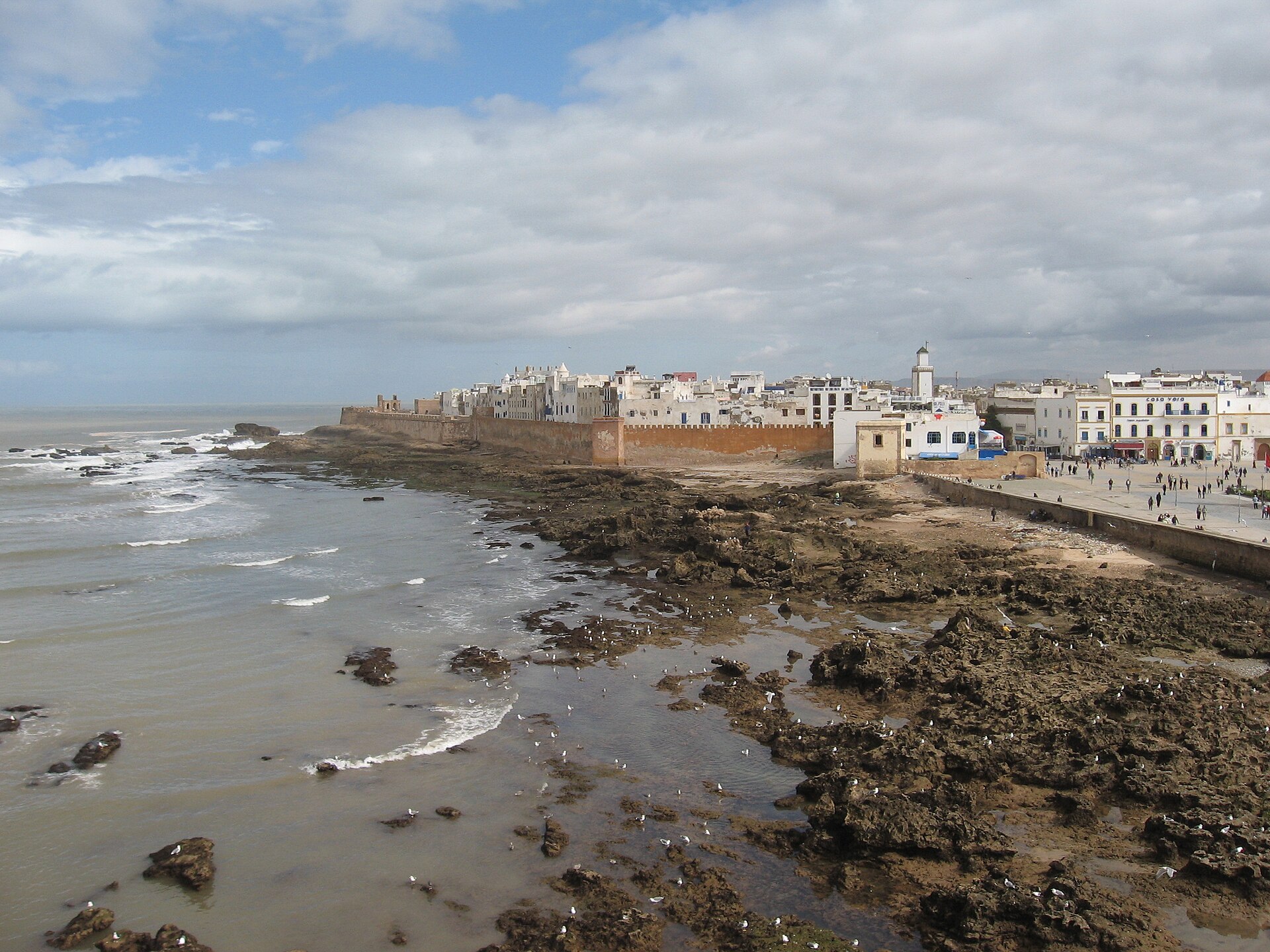
- The medina. Before leaving, he walked through the old town to the Sqala, where he watched the sun set over the Atlantic ramparts.
What to retain
The visit combines two layers: a strong political message on the Sahara, in line with the French stance already stated by Paris, and a cultural and educational agenda that illustrates the weight of French-language teaching in the Kingdom. The next political marker is the prospective bilateral treaty, whose content has not been made public.
Main image: the ramparts of Essaouira (file photo) — Kayaky, Wikimedia Commons, CC BY 3.0.
Sources
- Hespress FR — Sahara marocain : La France réaffirme sa position « intangible » de soutien à la souveraineté du Maroc
- Hespress EN — France Reiterates 'Unwavering' Position in Support of Morocco's Sovereignty & of Autonomy
- Le360 — À Essaouira, Jean-Noël Barrot se mêle aux passants dans la médina
- Hespress FR — Le Quai d'Orsay annonce Jean Noël Barrot vendredi au Maroc