






Tens of thousands of people took to the streets of Portugal on Saturday 14 November to denounce the cost of housing. Marches were held in more than 30 towns and cities, including Lisbon, Porto, Faro, Portimão, Coimbra and Braga, Al Jazeera reports.
The crowds mixed teenagers and retirees, families and students, many marching to the sound of drums. It was the latest and, according to the Associated Press as cited in press reports, one of the largest days of action in a movement that has been gathering strength for several weeks.
Who is behind the protests
The marches were called by Casa Para Viver ("A Home to Live In"), a platform that brings together around 100 housing associations and grassroots groups. Their slogan: "They will not steal our right to a home."
The organisers called on Prime Minister Luís Montenegro to open a dialogue with tenants and residents' groups.
What the protesters want
The platform's demands include:
- caps on rent increases;
- stronger protection against evictions;
- a large supply of genuinely affordable housing;
- the reversal of recent changes to rental law;
- tighter regulation of short-term holiday lets and of vacant homes.
Parliament recently approved reforms that make rental contracts more flexible and speed up eviction procedures. Tenants' groups see these changes as a step backwards.
Figures that explain the anger
According to Eurostat, the ratio between house prices and household income in Portugal rose by 61% between 2015 and 2025, the largest increase in the European Union. The Netherlands, in second place, recorded a rise of 34%.
The pace has not slowed. Portugal's National Statistics Institute reports that house prices rose by almost 20% between the first quarter of 2025 and the first quarter of 2026. The government itself says rents have risen by 68% since 2020.
Al Jazeera points to several factors behind the surge: purchases by foreign buyers and investment funds, the arrival of remote workers, and retirees settling in the country, often with higher incomes than local residents.
Voices from the march
One 40-year-old business owner told Al Jazeera that, despite running a company, they could not afford to buy a home. Another protester explained that he earns around €1,000 a month and pays €600 to €700 in rent: "It's impossible," he said.
These situations are common in Lisbon and Porto, where wages have not kept up with housing costs.
The government's response
The government points to the measures it has already taken:
- lower taxes on new construction;
- restrictions on short-term rentals in some areas;
- a pledge to build 145,000 homes.
Ministers acknowledge, however, that the effects of these policies "will not be immediate".
A movement that has hardened since October
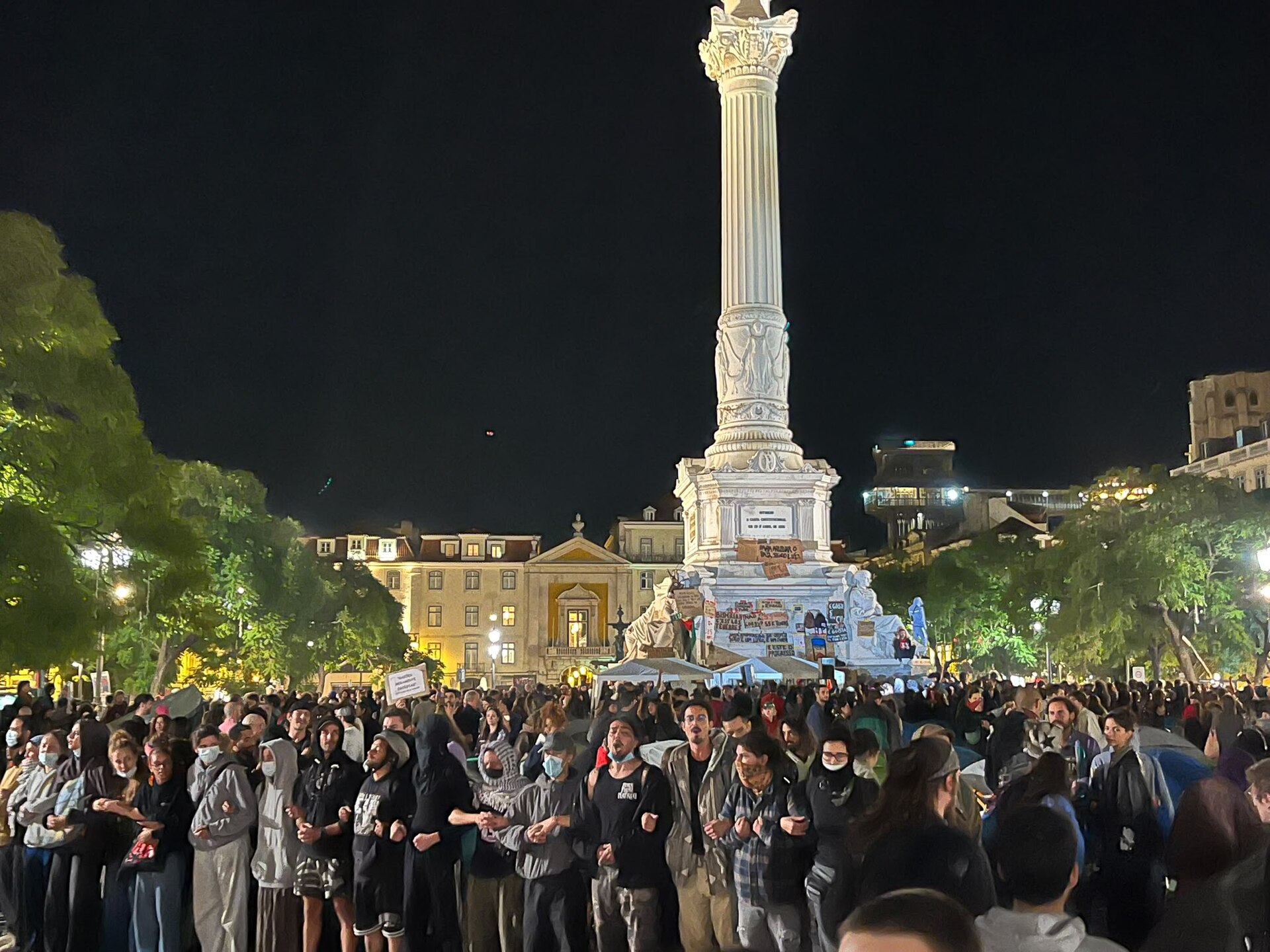
The housing movement has taken new forms in recent weeks. Activists set up protest camps in central squares in Lisbon and Porto. Press reports describe riot police with dogs dispersing some of these gatherings, and protesters have accused the police of heavy-handedness. Al Jazeera previously reported that police cleared a Lisbon camp in late October, with about 25 arrests.
The Portuguese movement also takes its cue from neighbouring Spain, where large housing protests took place last month.
What remains to be confirmed
- Whether the government will agree to meet the Casa Para Viver platform.
- The exact number of participants nationwide: the reports consulted give no official count.
- The timetable for the 145,000 promised homes and how they will be funded.
Main image: housing protest camp in Rossio square, Lisbon, October 2026 (file photo) — Afonso Dimas Martins, Wikimedia Commons, CC BY-SA 4.0.