








What happened
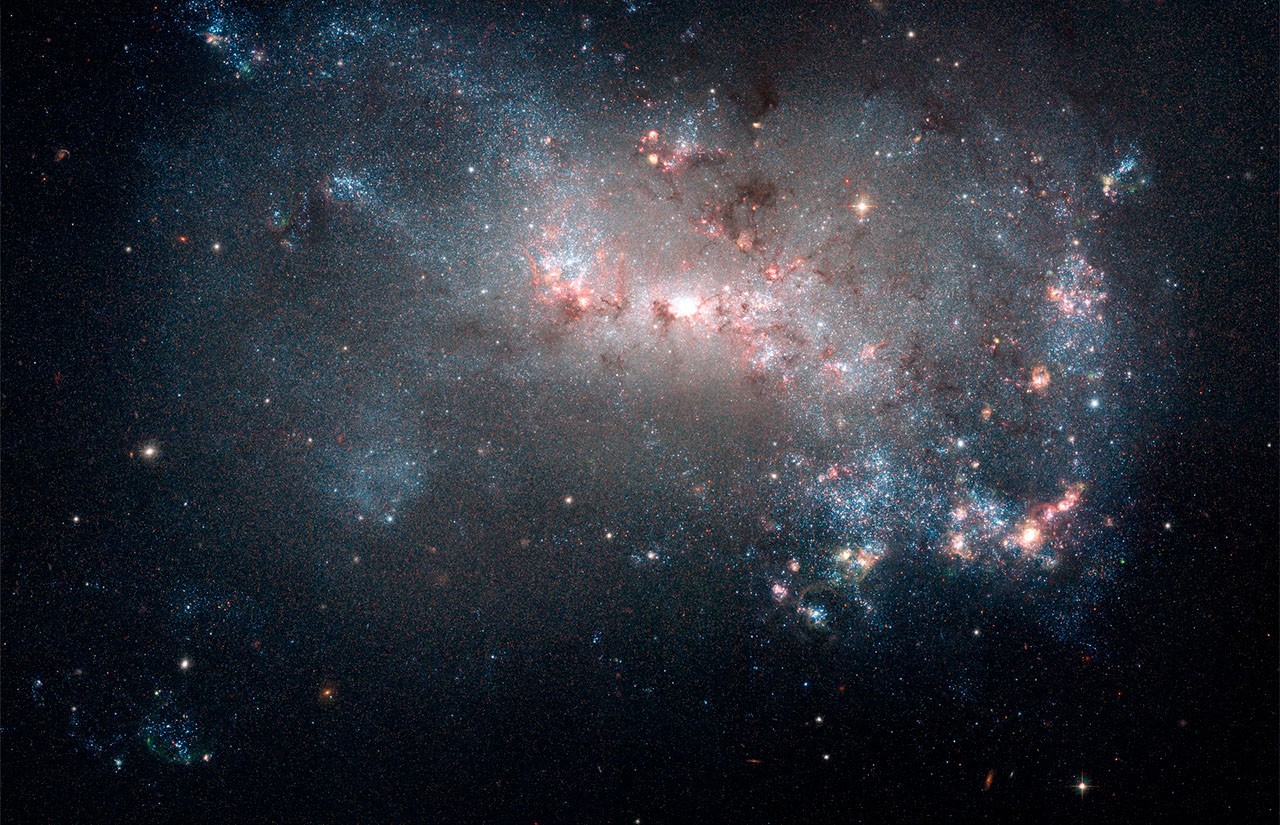
NASA's Astronomy Picture of the Day for 11 November shows NGC 4449, a dwarf galaxy imaged by the Hubble Space Telescope.
Small does not mean minor
Our own galaxy, the Milky Way, is about 100,000 light years across and holds hundreds of billions of stars. Dwarf galaxies are about 1/10 of its size and contain only a few billion stars, but they are the most common type of galaxy in the universe.
What the picture is used to explain
According to NASA's caption, NGC 4449 and similar dwarf galaxies are missing more oxygen than models predict. This suggests that their stellar winds and supernovae are surprisingly effective at blowing oxygen and other heavy elements out of the galaxy. These elements are the building blocks of stars, planets and life, so such tiny galaxies may play a big role in spreading them throughout the universe.
What remains to be confirmed
This article relies on a single source, the NASA caption, written by a professional astronomer. It states a possible explanation (“suggests”, “may”), not a proven one. It does not give the distance or size of NGC 4449.