









IBM has set out the next stage of its quantum computing roadmap. On 11 November 2026, the American group announced Nighthawk r3, a processor designed to execute 10,000 quantum operations on 520 programmable qubits, and confirmed its plan to build a system of more than 1,000 qubits in 2027.
"Useful quantum computing hinges on whether results can be delivered with accuracy and speed," said Jay Gambetta, director of IBM Research, in the company's statement.
Why the number of operations matters
A qubit, the basic unit of a quantum computer, can hold a combination of 0 and 1 at the same time. But qubits are fragile: each operation adds a small risk of error, and errors pile up as a calculation gets longer. That is why IBM now puts the emphasis on the number of operations a chip can run reliably — the depth of its circuits — rather than on the number of qubits alone.
Operations involving two qubits are the most error-prone. Being able to chain 10,000 of them on one chip would allow longer and more complex simulations, for example in chemistry or materials science.
Nighthawk r3: what is announced
According to IBM and the specialist site SiliconANGLE:
- Nighthawk r3 will have 520 programmable qubits, built from 2,034 physical qubits;
- it keeps the square lattice layout of the previous version, in which each qubit is connected to four neighbours;
- it is designed to run circuits of 10,000 two-qubit operations;
- it includes ten "l-couplers", links that carry quantum information between chips.
The processor is expected in 2027. IBM then plans to connect two Nighthawk r3 chips to form a 1,040-qubit system.
The current chip and its results
The version available today, Nighthawk r2, was introduced in September. It runs more than 7,500 operations on 120 qubits and can process up to 100,000 samples per second. IBM says its clients have already run 34 billion circuits on its machines.
The company reports speedups of up to 19 times compared with its earlier processors on concrete tasks:
- 15 times for the energy company E.ON;
- 12 times for a study of magnetic materials with Oak Ridge National Laboratory;
- 8 times for the Finnish start-up Algorithmiq, compared with the Heron processor.
For the Algorithmiq task, IBM estimates that classical tensor-network methods would have needed about 240 times more memory. Part of the gain comes from a much faster reset of the qubits between two runs.
These figures are IBM's own and compare its processors with each other. They do not show a "quantum advantage" over the best classical computers, a threshold the company is tracking through a public Quantum Advantage Tracker.
Linking chips together
The main technical challenge is connecting processors without losing information. IBM says its l-couplers have reached a state-transfer fidelity of 99.3%; its target is 99.9%.
The group has also joined two cryogenic modules and says the combined system can be cooled to below 15 millikelvin — colder than outer space — in less than five days.
Error correction
IBM's longer-term goal remains a fault-tolerant quantum computer, able to correct its own errors. The company says it is working with Oak Ridge National Laboratory and AMD on a platform combining quantum processors and conventional supercomputers to develop error-correction methods.
What remains to be confirmed
- The actual performance of Nighthawk r3 once it is built, beyond the design targets.
- Whether the 99.9% target for the links between chips will be reached in 2027.
- Independent confirmation of the speedups announced on clients' workloads.
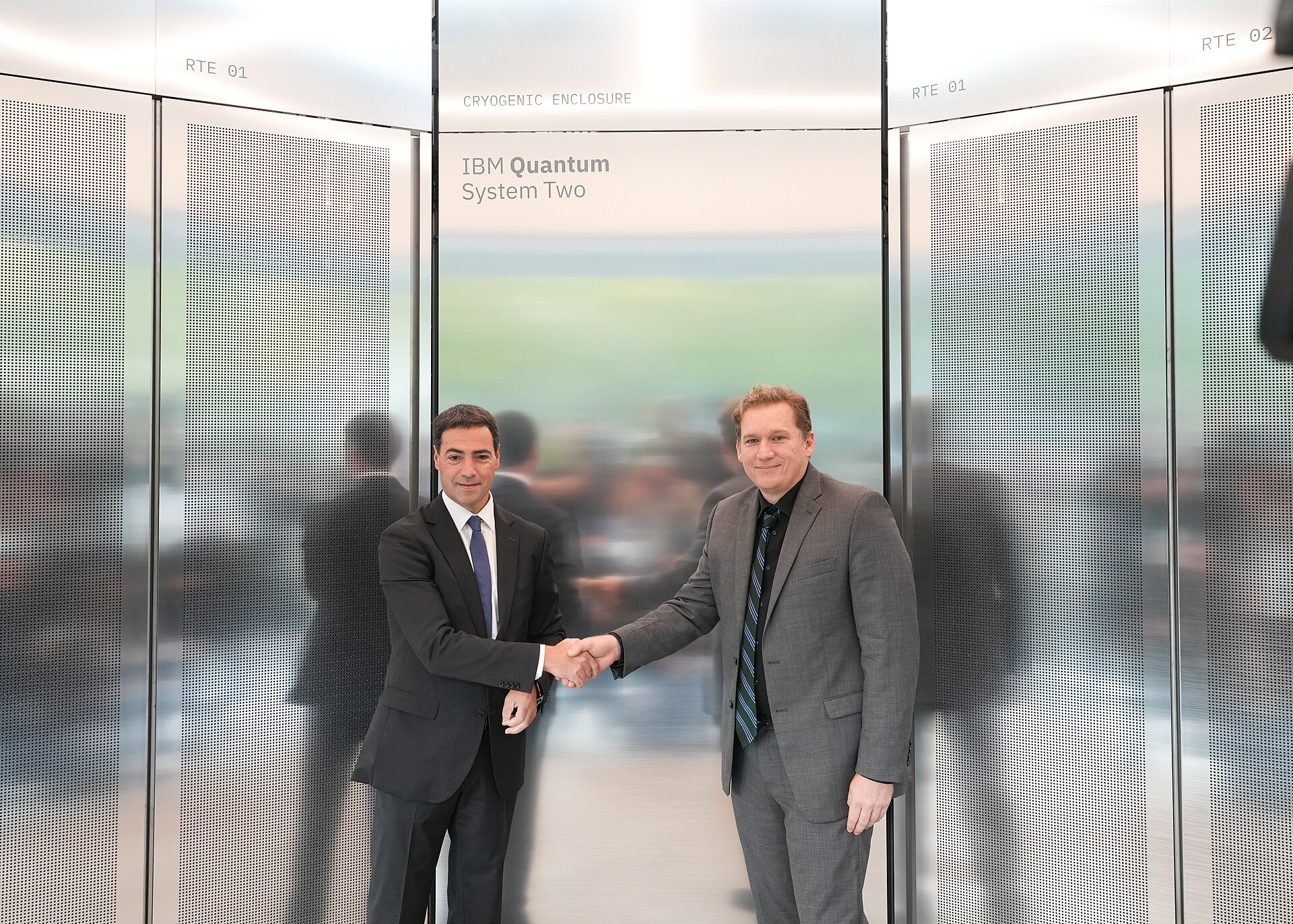
Main image: an IBM Quantum System Two in San Sebastián, Spain, in 2025 (file photo) — Irekia / Eusko Jaurlaritza, Wikimedia Commons, CC BY 4.0.
Sources
- IBM Newsroom — IBM Quantum Nighthawk Demonstrates New Levels of Speed and Quality, with Plans to Scale Beyond 1,000 Qubits in 2027
- SiliconANGLE — IBM Quantum announces upcoming Nighthawk r3 processor designed to execute 10,000 operations
- MarkTechPost — IBM Quantum Nighthawk r3: 520 qubits and a 1,040-qubit system in 2027