









The European Space Agency (ESA) has opened the first large public archive of its Euclid space telescope. The data release, called DR1-Foundation and published on 12 November 2026, contains more than a billion celestial objects, including over 900 million galaxies.
ESA's director of science, Carole Mundell, described it as "the largest space-based survey of its kind". The data are freely available to scientists and to the public.
What the release contains
DR1-Foundation is based on about thirteen months of observations, from spring 2024 to spring 2025. According to Caltech's IPAC centre, which takes part in the mission, it includes:
- about 1,900 square degrees of sky, the equivalent of some 9,500 full Moons, or roughly 14% of the area Euclid will map over six years;
- more than one billion detected objects, of which over 900 million galaxies;
- around 15,000 candidate strong gravitational lenses, more than all previous catalogues combined;
- more than 60 million quasar candidates;
- spectra for more than 160 million sources;
- a total volume of about 1.7 million gigabytes.
A mosaic of 740 observations covering 367 square degrees has also been assembled. The data can be explored through the Euclid Data Space and the ESASky portal.
Why gravitational lenses matter
A strong gravitational lens appears when a massive galaxy or cluster bends the light of a more distant object behind it, producing arcs or rings. These configurations make it possible to "weigh" the matter in the foreground galaxy, including the dark matter that cannot be seen directly.
Until now, astronomers knew only about a thousand confirmed lenses. A sample of this size will allow statistical studies, ESA says. The release also reveals the faint intracluster light — stars scattered between galaxies — in hundreds of galaxy clusters.
A mission to study the dark Universe
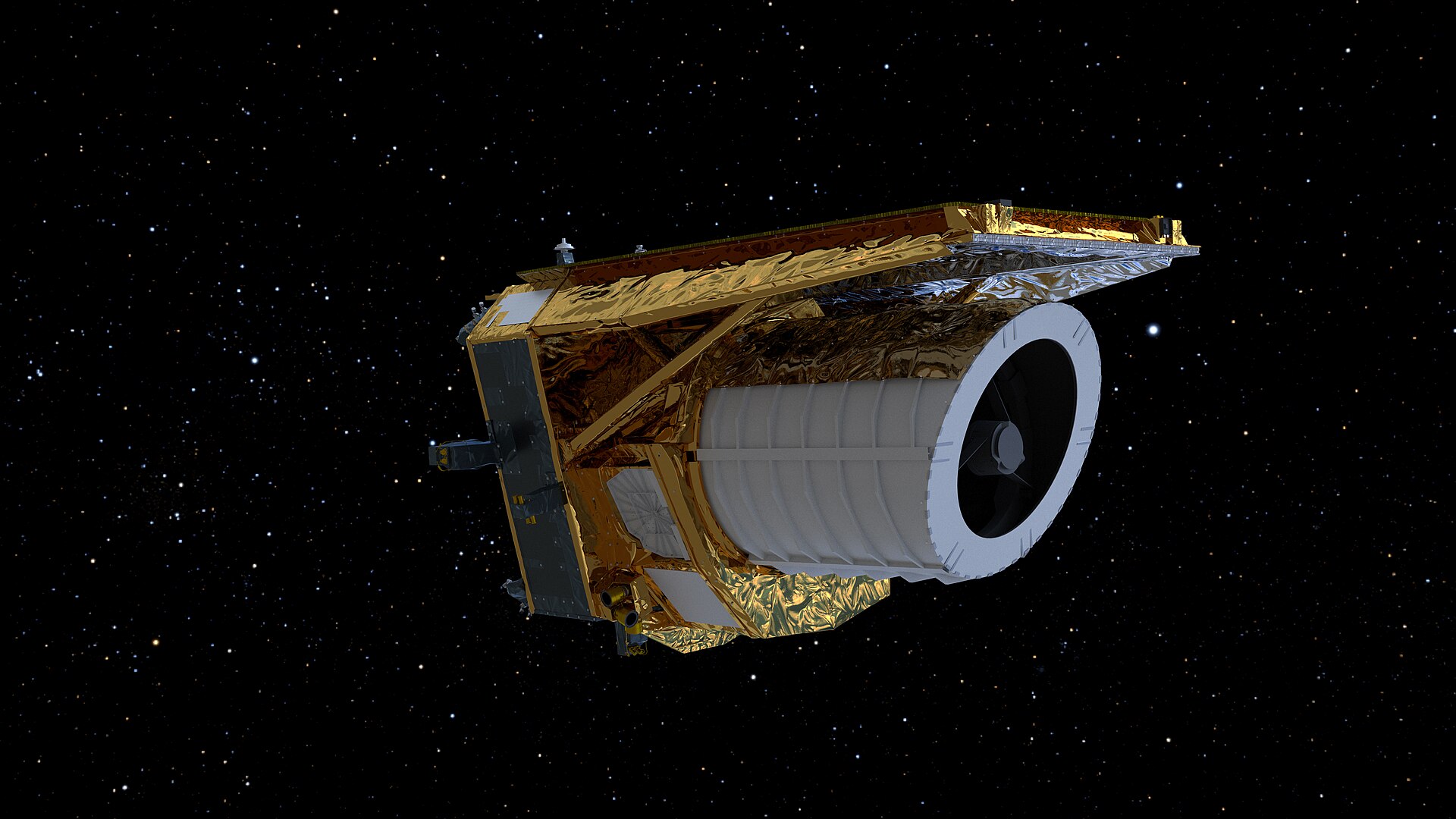
Euclid was launched on 1 July 2023 on a Falcon 9 rocket and orbits about 1.5 million kilometres from Earth, at the L2 point. With its 1.2-metre telescope, it photographs the sky in visible light and in the near infrared. NASA supplied the detectors for its near-infrared instrument, NISP.
The aim is to understand dark energy and dark matter, which together make up about 95% of the Universe. To do this, Euclid measures the shapes and distances of billions of galaxies over the last ten billion years of cosmic history.
The Euclid Consortium brings together more than 2,000 scientists from some 300 institutes. Several of its researchers, including Valeria Pettorino of ESA, say the release is only a first step.
A data challenge
Handling 1.7 million gigabytes is a task in itself. The images and catalogues are processed by a network of science data centres in Europe and the United States before being made public. ESA says researchers can query the catalogues online and download only the data they need, rather than the whole archive.
Euclid began routine science operations on 14 February 2024. Its Wide Survey is meant eventually to cover about 14,000 square degrees, roughly a third of the sky, avoiding the bright band of the Milky Way and the zodiacal light of the Solar System.
What comes next
This publication follows smaller "quick" releases in 2025 and 2026. The full DR1 is planned for mid-2027. It will add the measurements of weak gravitational lensing — the tiny distortions of galaxy shapes — needed to map the cosmic web and test cosmological models.
What remains to be confirmed
- How many of the 15,000 lens candidates will be confirmed by follow-up observations.
- The first scientific results drawn from the release, which are only beginning to appear.
- The exact date of the full DR1, announced for mid-2027.
Main image: artist's impression of the Euclid spacecraft (illustration) — European Space Agency, Wikimedia Commons, CC BY-SA 3.0 IGO.