





One of the most productive space telescopes of the century is gone. NASA's Neil Gehrels Swift Observatory re-entered Earth's atmosphere on Wednesday 4 November 2026 at 7:39 a.m. EST (7:39 p.m. Western Indonesia Time), over North Sumatra, according to the US Space Force. The spacecraft, which weighed about 1,450 kilograms (3,200 pounds), ended a mission designed to last two years — almost 22 years after its launch.
Why Swift came down
Swift was launched on 20 November 2004 into low Earth orbit, with no propulsion system to raise its altitude. For two decades that was not a problem. But the most recent solar maximum, which peaked in 2024, heated and expanded the upper atmosphere, sharply increasing the drag on satellites in low orbit.
Swift's orbit decayed faster than expected. By 20 October 2026 it had fallen to about 275 kilometres, and the spacecraft was placed in safe mode after making its final scientific observation. From then on, re-entry was only a matter of days.
The rescue that never happened
NASA did try to save the observatory. In September 2025 it awarded a $30 million contract to the start-up Katalyst Space for a robotic servicing vehicle, called LINK, designed to dock with Swift and push it to a higher orbit. The spacecraft was built in about nine months and launched on 3 July 2026.
But LINK suffered an anomaly in its attitude-control system. On 19 August, NASA announced that no capture or reboost would be attempted, and the rescue mission formally ended on 25 September. Separately, the agency has since issued a call to industry on options for raising the orbit of the Hubble Space Telescope, which faces the same long-term problem.
What Swift leaves behind
Swift was built to catch gamma-ray bursts, the most powerful explosions in the universe, which flash for a few seconds to a few minutes before fading. Its strength was speed: it could detect a burst and turn its X-ray and ultraviolet/optical telescopes towards it within about a minute, before the afterglow disappeared.
The scientific record is impressive:
- More than 2,000 gamma-ray bursts detected
- More than 1,400 supernovae observed
- About 7,000 scientific papers based on its data
- More than 1.5 million images from its ultraviolet/optical telescope
- A public archive of about 12 terabytes
In 2005, Swift observed GRB 050509B, the first short gamma-ray burst for which an afterglow was detected — a key step towards showing that these short bursts come from mergers of neutron stars. In 2018 the observatory was renamed in honour of Neil Gehrels, its late principal investigator.
Shawn Domagal-Goldman, a NASA astrophysics official, said the mission delivered "an incredible, lasting return on investment". Penn State astronomer John Nousek, who worked on Swift from the start, put it more simply: "what goes up must come down."
Was there any danger?
Large satellites do not burn up completely. Astrophysicist Jonathan McDowell estimated that about 100 kilograms of Swift could have survived re-entry. According to an estimate cited by Parker Wishik of The Aerospace Corporation, the risk of injury to someone on the ground was about 1 in 2,100 — higher than the 1 in 10,000 threshold that NASA normally applies to new missions, a standard that did not exist when Swift was designed.
As of 6 November, no debris had been confirmed on the ground.
What remains to be confirmed
- Whether any fragments reached the ground in Sumatra or at sea.
- The final assessment of the LINK anomaly by Katalyst Space and NASA.
- The timetable for a possible Hubble reboost mission.
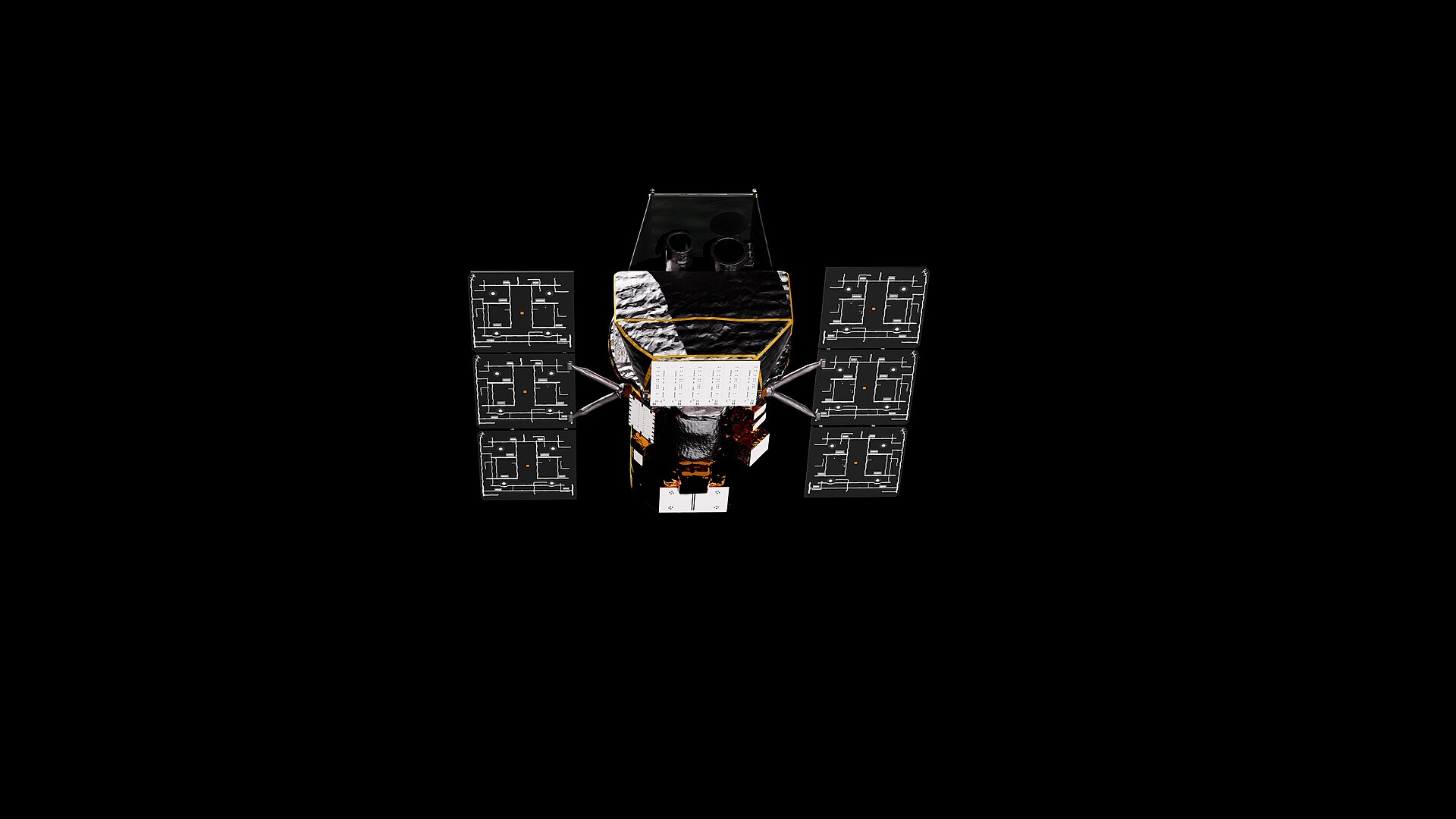
Main image: artist's concept of the Swift spacecraft — NASA's Scientific Visualization Studio, public domain, via Wikimedia Commons.